Component sourcing
Review supply options for specified components, including hard-to-find parts and small quantities.

SEMICONDUCTOR SOURCING & SUPPLY SUPPORT
Start with the components holding up your next build.
01 / THE SUPPLY GAP
Your usual purchasing channels cover most of the board. But a constrained part, an unworkable minimum order or a cost target can still hold up the next build. We focus on the remaining component requirements that need individual attention.
02 / OUR APPROACH
Start with the part numbers, quantities and build date. We review potential sourcing routes, clarify availability and supply conditions, and identify alternative candidates where appropriate. You decide what fits your design and qualification requirements.
Explore our capabilities ↗03 / CORE CAPABILITIES
Review supply options for specified components, including hard-to-find parts and small quantities.
Compare candidate specifications, supply conditions and cost trade-offs for your engineering review.
Align agreed component quantities and delivery conditions with your next build milestone.
04 / APPLICATION FOCUS
We review prototype and pilot component requirements for edge AI vision boards, robot controllers and distributed energy hardware. The sourcing scope follows the board function and your selected platform—not a fixed list of promoted parts.
Built for prototype and pilot runs, with supply continuity reviewed as your project grows.
See how a supply review works ↗05 / WHAT YOU RECEIVE
A review can cover availability at the time of checking, proposed quantity and lead time, supply conditions, and any alternative candidates requiring further validation. Supplier-provided visual, marking and packaging checks, source documentation, and third-party testing support are available. We confirm the required scope before an order is agreed.
A sourcing review is not an engineering approval or a guarantee of future availability. No substitutions are made without your approval.
APPLICATIONS / PROJECT INPUTS
Select your project context to see what to share and what a review can cover.
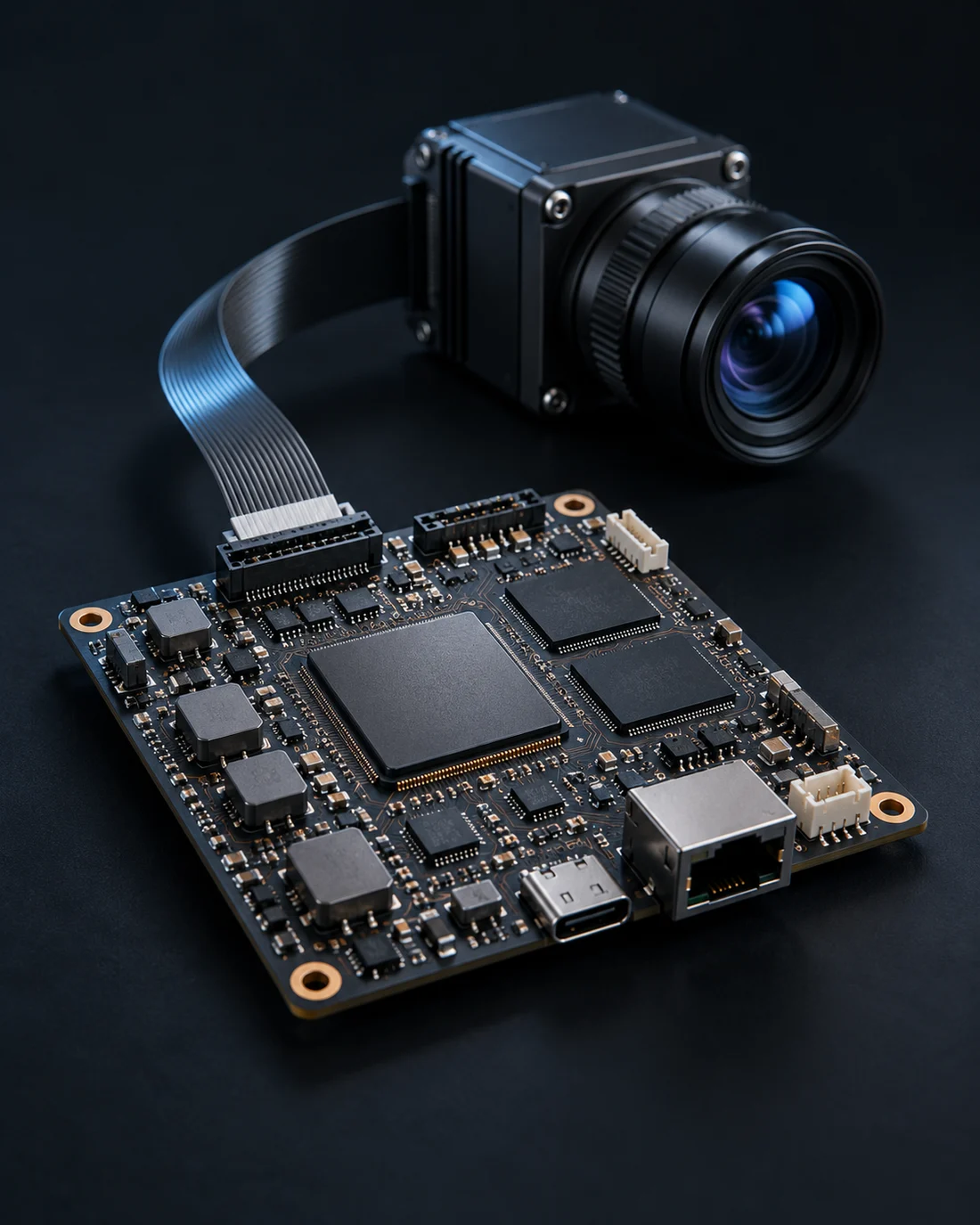 APPLICATION CONCEPT / AI-GENERATED
01 / EMBEDDED VISION BOARD
A vision prototype also depends on its power rails, boot storage, working memory, sensor interfaces and board communications. Start with the selected platform and the exact constrained components.
Platform compatibility and any substitutions require customer engineering validation.
Discuss Your Component Requirements ↗COMPONENT SCOPE / BY BOARD FUNCTION
We organize sourcing enquiries around the functions in edge AI vision, robotics and distributed energy hardware. These are the requirements we review—not a claim that every device is stocked or technically supported. Exact parts, sourcing feasibility and any supplier engineering support are confirmed per project.
01 / SOURCING REVIEW SCOPE
DC/DC converters · LDOs · Power sequencing · eFuses · Battery monitors and protection ICs
Power rails for embedded vision boards, battery-powered robot controllers, and distributed energy BMS prototypes.
To review: Input and output ranges, rail sequence, load profile, battery architecture and protection requirements.
02 / SOURCING REVIEW SCOPE
Gate drivers · MOSFETs · Motor-driver ICs · Current sensing · Position-sensor interface components
Joint, actuator and motor-control boards for humanoid, collaborative and other robotics projects.
To review: Bus voltage, motor topology, switching conditions, sensing requirements and thermal constraints.
03 / SOURCING REVIEW SCOPE
Operational and instrumentation amplifiers · ADCs · Current-sense amplifiers · References · Digital isolators
Sensor inputs, measurement circuits, motor feedback and BMS current or voltage acquisition.
To review: Signal range, accuracy, bandwidth, isolation, temperature and the exact circuit function.
04 / SOURCING REVIEW SCOPE
Microcontrollers · CAN / CAN FD transceivers · RS-485 transceivers · Ethernet PHYs · Interface bridges
Board control and communication between robot subsystems, embedded vision peripherals and energy controllers.
To review: Host platform, protocol, software dependencies, pinout, package and temperature grade.
05 / SOURCING REVIEW SCOPE
SPI NOR Flash · eMMC · DDR / LPDDR memory
Boot, firmware, working memory and local storage for embedded edge AI and controller platforms.
To review: Processor compatibility, capacity, organization, voltage, speed grade, package and validated ordering code.
LoRa and other wireless parts, power connectors, image sensors and application processors can be included when the project calls for them. Start with the selected part or platform and its constraints. Availability and the extent of technical assistance require a separate review.
Examples describe component functions, not approved replacements, live inventory or manufacturer authorization. Your engineering team approves suitability and any design changes.
SUPPLIER-SUPPORTED VERIFICATION
Our suppliers can provide component inspection, source documentation and third-party testing support. We coordinate the required scope with you before an order is agreed.
Supplier-provided checks of component appearance and physical condition.
Supplier-provided review of device markings, date codes and lot information where available.
Supplier-provided review of packaging condition, labels and packing details.
Supplier-provided sourcing and traceability documents. The available documents and their coverage are confirmed for each supply option.
Third-party testing can be arranged through our suppliers. The laboratory, test methods, report deliverables, cost and lead time are agreed before testing.
Inspection and documentation are provided by our suppliers; third-party testing is performed by the agreed laboratory. Methods, document availability and any additional charges are confirmed for the specific order.
BLOG / ENGINEERING NOTES
Compare circuit requirements, specifications and validation questions before changing a part.
Review the capture-to-inference supply path, including memory, interfaces and power.
Connect the component supply plan to the next board and assembly milestone.
MOVE YOUR PROJECT FORWARD